Why Your Website Is Quietly Costing You $500,000 a Year
Most daily fee golf courses already have enough demand to make more money than they do today. The problem is rarely traffic. The problem is that too many golfers who want to book never complete the process. In many cases, fixing how bookings actually work online can unlock hundreds of thousands of dollars in additional revenue without adding holes, staff, or marketing spend.
This article explains where that money is being lost, why it happens at so many courses, and what usually needs to change first. None of this is complicated. Other industries solved these problems years ago. Golf just hasn’t caught up.
Your website is the first interaction
For most public golf courses, the first real interaction with a golfer does not happen on the property. It happens earlier, usually on a phone, when someone is deciding where to play. At that moment, your website is standing in for your pro shop and your front desk.
Your website is working every day whether you think about it or not. It either helps golfers book or pushes them elsewhere. There is no neutral outcome. If your website were a human employee, most courses would have fired it a long time ago. In any business, you do not keep people around who work against you.
What is actually going wrong
Most golf course websites were built to show information, not to make booking easy. Photos, rates, directions, maybe a short story about the club. That approach does not match how people behave today.
In every other business that sells time or experiences, hotels, airlines, gyms, restaurants, the process is simple. You see availability, you choose, you pay. Golf should not be different, but often it is.
What we usually see is a collection of small problems. Pages are slow. Tee times are hard to find. The booking process feels confusing on a phone. There are too many steps before payment. Golfers are asked to create accounts before they can book. Each issue seems minor on its own. Together, they cause people to give up.
Why small improvements have a huge impact
When we talk about conversion, we’re referring to tee-time bookings, not individual golfers. A single booking typically covers more than one paid round. To be conservative, let’s assume there are only two players per booking, although some industry studies indicate that the average is significantly higher, specifically 2.6 players per booking.
The key is that no drastic changes are needed to generate significant results. Let’s imagine that small improvements in the booking process manage to generate just four additional bookings per day. That doesn’t seem like a particularly large number.
However, even assuming only two players per booking, that amounts to eight additional paid rounds each day. Over the course of a year, the cumulative impact amounts to approximately 2,900 additional rounds, generated simply by removing friction from the booking process. Assuming an average rate of $60 per round, those 2,900 additional rounds represent approximately $174,000 annually in green fee revenue.
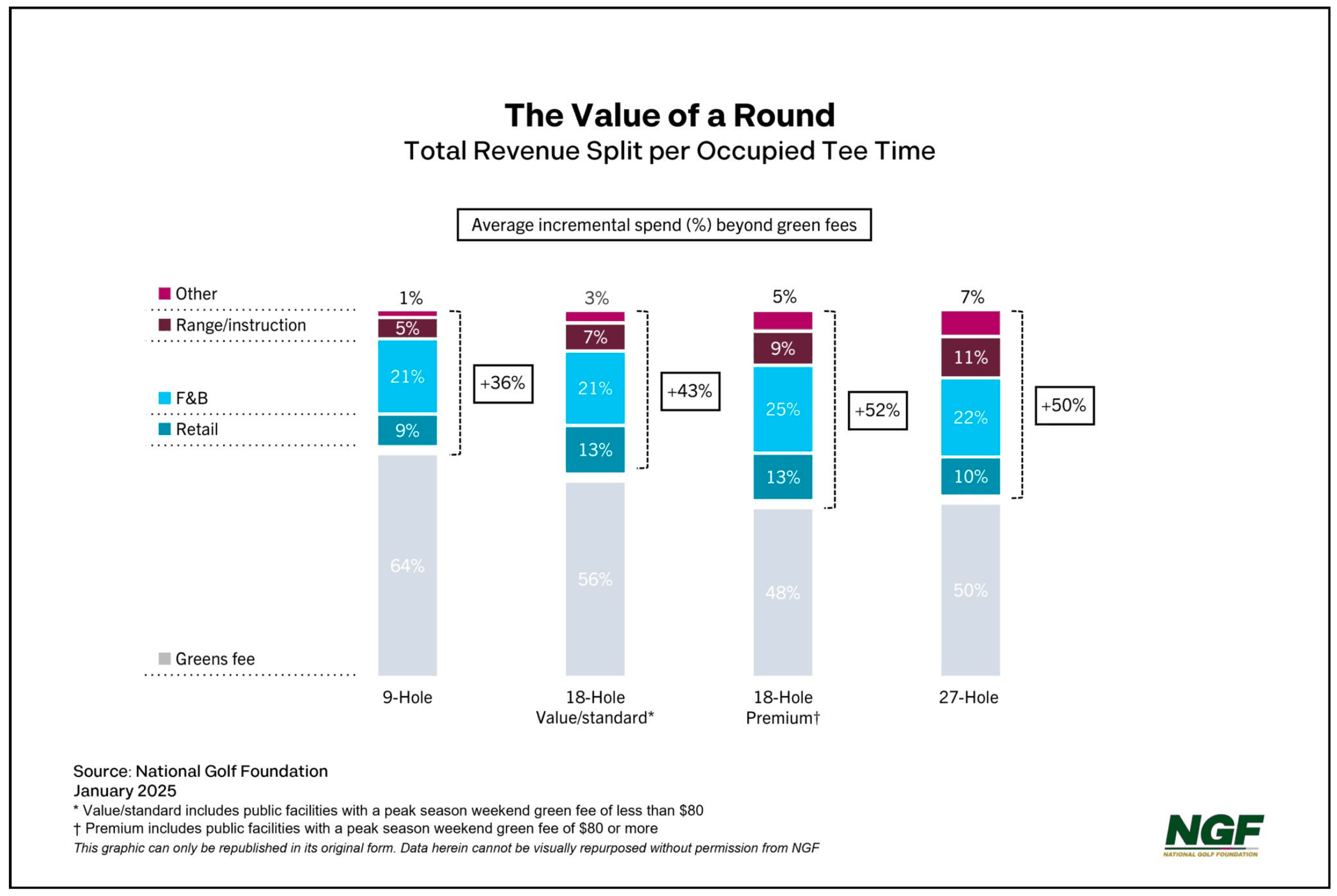
According to data from the NGF (National Golf Foundation), green fees account for only about 60% of a golfer’s total spending (see the images below). The remaining 40% comes from buggies, food and beverages, equipment, rentals, and the driving range. When we include everything, the total impact approaches $290,000 per year.
And that example assumes just one small improvement generating only four additional bookings per day. When similar improvements are applied across the website and booking journey, and website traffic increases even modestly, the impact can easily exceed $500,000 per year. Even those figures are conservative.
Most golf course websites are poorly designed and difficult to use, and even if the golfer finds the booking button, the booking process itself often does an excellent job of destroying any desire to complete the reservation.
And let's keep in mind that this example assumes website traffic remains exactly the same. We have not even touched on the topic of increasing website traffic, something I have helped businesses do for more than 15 years. When higher traffic is combined with higher conversion rates, the revenue impact becomes substantially larger.
How we help without disrupting your operation
We do not replace systems or rebuild websites. Most courses do not need that. We start with what you already have and focus on removing what gets in the way.
That means cleaning up pages, simplifying booking paths, and eliminating unnecessary steps. No new tools, no retraining, and no disruption. Just making things easier for your customers.
When booking becomes easier, golfers complete what they start. They stay longer on the site, they click more, and they finish bookings.
This is only the starting point
Fixing bookings is the first step. Once that works, you start collecting better data. That allows you to improve reviews, encourage return visits, and stop relying on the hope that golfers come back on their own. Which, by the way, they don’t. There is also pretty compelling data on this.
When golfers return consistently, membership finally makes sense. For many courses, membership models are outdated and misaligned with how people actually play today. We talk more about this in our article: The Future of Public Golf Memberships: Increasing Golfer Lifetime Value
The bottom line is this: The website gets golfers in the door. The experience brings them back. Consistency turns visitors into long term customers.
That is where real revenue growth comes from.
Interested to learn more? Just book a 30 min call with me.
Teemu
Founder
Growth Golf & Country Club
Miami, FL, USA